New York has strong tax incentives for businesses looking to innovate in the state. Not only does it support credits for a wider array of industries than the federal government’s research and development tax credit, but it also offers extra incentives for businesses pursuing environmentally friendly projects. These are projects that aim to reduce greenhouse gasses or create clean energy solutions.
If you’re a business operating and trailblazing in New York, it’s worth the time and effort to pursue these credits because of the potential return. From real estate to employment, you can get credits in multiple categories, which means more returns for your business.
Navigating the application process and understanding what your business is eligible for can be complicated. Turn to tax experts, like Boast, to help you maximize your return. If you want to learn more about R&D tax credits, check out our comprehensive guide.
What Are R&D Tax Credits?
The R&D Tax Credit program is a general business tax credit under Internal Revenue Code section 41 for companies that incur research and development costs in the United States. It has been around since 1981. Under the R&D Tax Credit program, the US government provides billions of dollars every year to innovative businesses for developing new or improving existing technologies, products, materials, and processes.
Use Our R&D Tax Credit Calculator To Calculate Your Tax Refund
R&D Tax Credits in New York
New York has a robust program for R&D tax credits. Businesses can get 6% back of whatever amounts to 50% of their federal research and development tax credit for qualified research expenses (QREs) that are purchased in New York. For qualified green projects, it’s even higher at 8%.
NY’s R&D tax credit is housed within the state’s Excelsior Jobs Program, which boasts five separate tax credits for innovative businesses. Some of which are:
- Jobs tax credit – up to 6.85% of wages per net new job and up to 7.5% of wages for qualified green projects
- Investment tax credit – 2% of qualified investments, 5% of qualified investments in qualified green projects, and up to 5% of qualified investments in child care services
- Child care services tax credit – up to 6% of net new child care services expenses for operation, sponsorship, or direct financial program support
In addition, there’s also a real property tax credit for businesses located in “certain distressed areas” and for regionally specific projects.
New York also funds a Life Sciences Research and Development Tax Credit Program for life sciences organizations relocating to and operating in the state. The life sciences tax credit is 15% for a company that employs 10 or more persons and 20% for a company that employs fewer than 10 persons. This is a fully refundable credit that businesses can receive in cash. Businesses should be aware that the credit is capped at $500,000 per year, and they can only claim it for three years.
Which businesses are eligible for these credits?
Businesses applying for any or all of the credits must be a part of these specific industries and meet certain minimum new job creation targets:
- Scientific research and development firms – 5 net new jobs
- Software development firms – 5 net new jobs
- Financial services (customer service) back-office operations – 25 net new jobs
- Agriculture firms – 5 net new jobs
- Manufacturing firms – 5 net new jobs
- Back-office firms – 25 net new jobs
- Distribution firms – 50 net new jobs
- Music production firms – 5 net new jobs
- Entertainment companies – 100 net new jobs
- Life sciences companies – 5 net new jobs
- Other firms – 150 net new jobs and investing at least $3 million
To qualify as an eligible green project for the additional credit, companies must be in the agriculture, manufacturing, software development, or scientific research and development industries. They must be actively working on a project that supports products or technologies aimed at reducing greenhouse gasses or creating clean energy.
How To Claim New York’s State R&D Tax Credits
Businesses interested in claiming the credit must first complete a consolidated funding application and submit it to their respective Empire State Development (ESD) regional office. The application can be found here. When it’s approved, the business will enter into an agreement with the state stating it’ll meet the job and investment requirements in return for the tax credits.
The New York state tax credits can only be claimed if the tax returns are filed on a timely basis. In order to receive a certificate of tax credit for subsequent taxable years, the business must submit a performance report demonstrating that it continues to satisfy the applicable eligibility requirements within 30 days of the end of its taxable year.
What Qualifies as R&D Expenses in New York State?
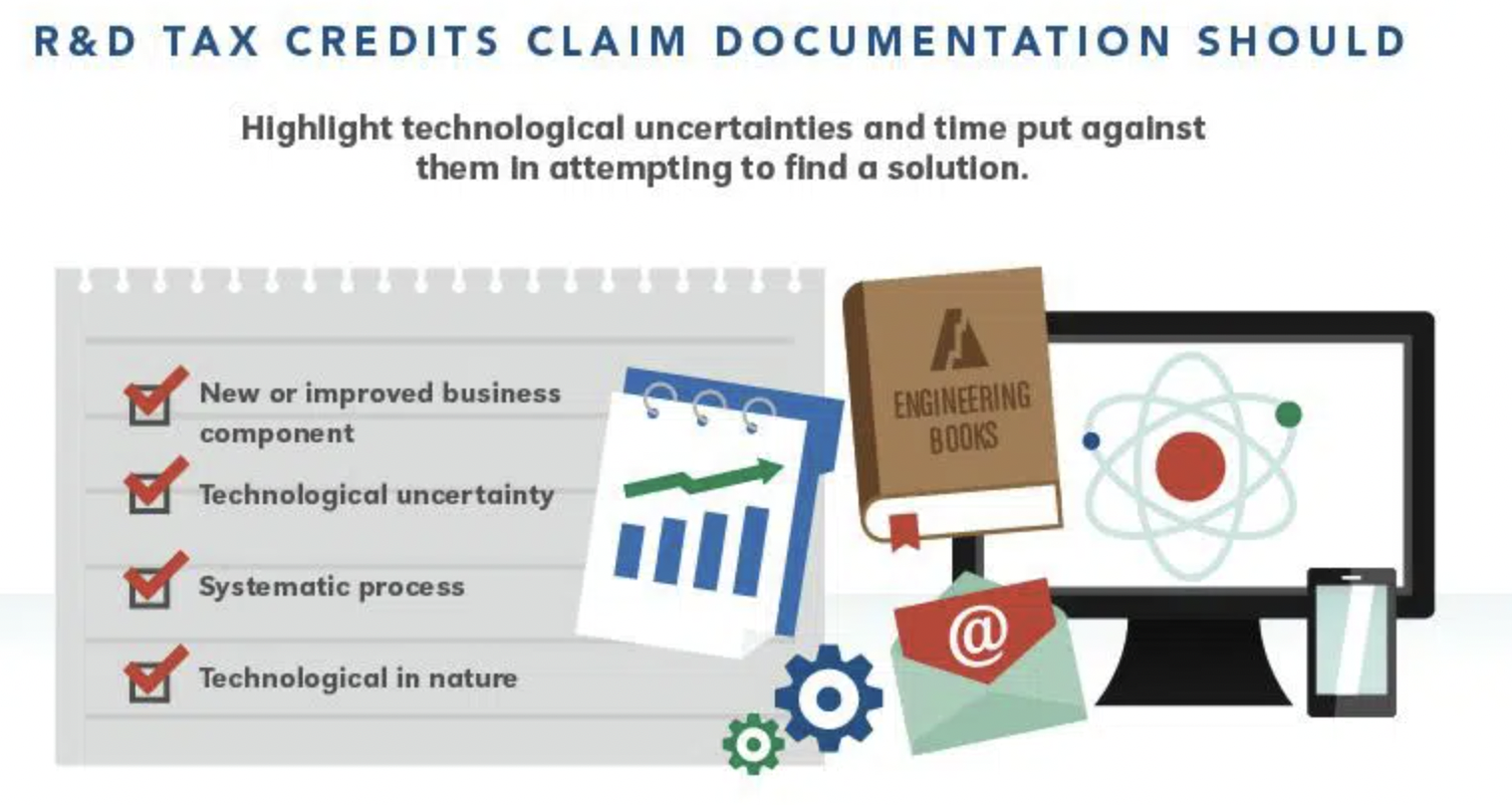
Four broad categories define research and development work, also known as qualified research activities (QRAs). They include:
- Improved business component – Work performed to develop new or improved products or processes
- Technological uncertainty – Work to solve problems or develop methods not previously resolved with publicly available knowledge
- Process of experimentation – Systematic work to evaluate one or more alternatives
- Technological in nature – Activities in physical sciences, biology, engineering, or computer science
Expenses that fall into one or more of these categories, known as qualified research expenses (QREs), and that can be applied toward the tax credit include:
- Brevets
- Fournitures de R&D
- Salaires des employés américains
- Salaires des sous-traitants américains
- Frais d’hébergement (location de serveurs ou d’autres technologies hors site)
Frequently Asked Questions About R&D Tax Credits
What can you recover with R&D tax credits?
R&D tax credits are available at both the federal and state levels. The federal credit is about 10% of eligible expenses and can be used to offset up to $250,000 per year in Social Security taxes, as well as income taxes or the alternative minimum tax (AMT). State credits vary by state.
What are the benefits of R&D tax credits?
You can use R&D tax credits to offset the employer portion of Social Security taxes, up to $250,000 per year.
The Social Security tax offset lets eligible small businesses benefit from their research activities, even if they aren’t profitable. R&D tax credits can also be used to reduce income taxes if you owe them, based on your previous tax returns.
R&D tax credits can also offset the alternative minimum tax (AMT) if your average revenue for the past three years is under $50 million and you owe AMT this year.
How do you prepare documents for R&D tax credits?
While the R&D Tax Credit program can help your business recover a significant portion of your R&D spending, claiming these credits is complex. You’ll need to provide receipts and invoices as proof of your QREs.
The IRS and state revenue agencies have their own requirements, but many follow the federal guidelines for their state credits. Required documentation includes:
- Documents must be contemporaneous, meaning you need to record R&D expenses as they happen. The larger your claim, the more documentation you’ll need.
- You must prove the work was performed in the fiscal year you’re claiming. All supporting documents for QREs must be dated.
- Your claim should highlight technical challenges and provide evidence of the R&D work performed. These challenges should fit one of the four main categories (as defined by the IRS) that qualify as R&D.
Tax professionals with industry expertise can ensure your R&D tax credit claim is well-supported and provide clear explanations of your R&D activities in case of an IRS audit.
Boast Finds Your Credits — With No Upfront Fee
Boast combines AI-driven software that identifies credit opportunities with the professional expertise of our in-house R&D and SR&ED tax specialists. We'll help your business secure larger returns faster and with less effort.
Our team consists of engineers and finance professionals with more than 20 years of experience. We stay engaged with your business year-round to help you identify R&D-eligible work, which also allows us to provide information on other technology grants and financing opportunities.
If the IRS reviews your R&D claim, we'll defend you throughout the process and work to ensure your claim succeeds. Get in touch with us now to request a free assessment and start your next R&D claim.