Every year, the U.S. government allocates billions of dollars to support innovative businesses that develop new technologies or improve existing products, materials, and processes through the R&D Tax Credit program.
If you’re a qualified small business or startup, you can use R&D tax credits to offset up to $250,000 per year in Social Security taxes—often received as a refund check from the IRS.
Since every business needs capital for innovation and growth, claiming R&D tax credits is one of the cheapest ways to maximize capital and reduce tax liabilities.
What is the R&D Tax Credit?
The R&D Tax Credit is a federal business tax incentive under Internal Revenue Code section 41 for companies that incur research and development costs in the United States. This program has been in place since 1981. Through the R&D Tax Credit, the U.S. government provides billions of dollars each year to innovative businesses that are developing new or improved technologies, products, materials, and processes.
What Can You Recover with R&D Tax Credits?
The R&D tax credits you can recover are divided into two parts: federal and state. The federal portion is typically about 10% of eligible expenses and can be used to offset Social Security taxes (up to $250,000 per year), income taxes, or the alternative minimum tax (AMT). The state portion, however, varies depending on the state.
R&D Tax Credits in New York
In New York, the state credit is capped at 3% of qualified research expenses. However, you can also claim up to 50% of your federal R&D credit related to R&D expenditures within New York State. Plus, there are several other tax credit programs available to support job creation, business expansion, and innovation. You can participate in the Excelsior Jobs Program, Start-Up NY, the Life Sciences Tax Credit Program, and more. You’ll find the complete list of tax credits here.
For example, the Excelsior Jobs Program offers credits to companies in sectors like biotech, pharmaceuticals, high-tech, clean technology, financial services, agriculture, and manufacturing that make significant capital investments or create new jobs.
Every business approved for the Excelsior Jobs Program can also apply for the jobs tax credit and the investment tax credit. Some companies may also qualify for the real property tax credit.
To qualify for the state R&D tax credit, your company must create net new jobs, depending on your industry:
- Scientific R&D: at least 5 net new jobs.
- Software Development: at least 5 net new jobs.
- Agriculture: at least 5 new jobs.
- Manufacturing: at least 10 net new jobs.
- Financial services (customer service) back-office operations: at least 50 net new jobs.
- Distribution: at least 75 net new jobs.
- Music Production: at least 5 net new jobs.
- Entertainment: at least 100 net new jobs.
- All other types of companies must create at least 300 net new jobs and invest at least $6 million.
What You Need to Claim New York’s State R&D Tax Credits
You can only claim New York State tax credits if you file your tax returns on time. To receive a certificate of tax credit for future tax years, you must submit a performance report within 30 days after your tax year ends, showing that you continue to meet all eligibility requirements.
Strict guidelines apply to R&D tax credit eligibility. For example, qualifying activities must pass a four-part test that looks at: Permitted Purpose, Elimination of Uncertainty, Process of Experimentation, and Technological in Nature.
Finally, your company must complete Form RPD-41298, Research and Development Small Business Tax Credit Claim Form, and submit it with your CRS-1 Form. Any excess R&D tax credit is refundable, and eligible businesses can claim the credit over a 10-year period.
FIND OUT IF YOU QUALIFY FOR R&D TAX CREDITS – FREE ASSESSMENT
New York R&D Tax Credit Case Study
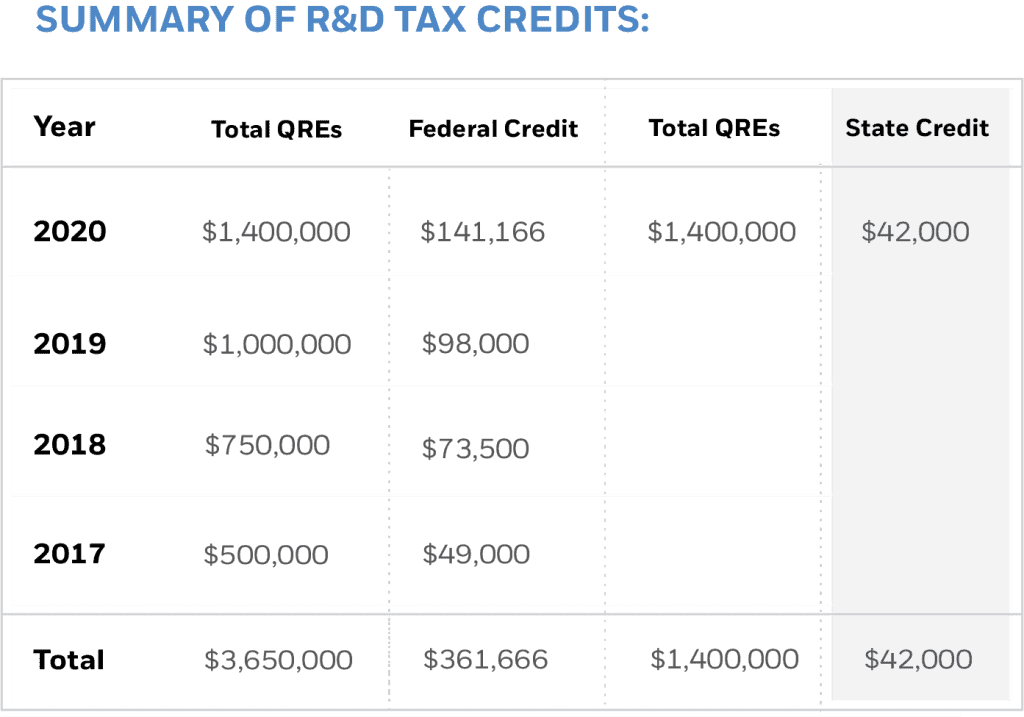
A New York pharmaceutical company had never claimed the R&D credit before. This project covered multiple years, from 2017 to 2020. Based on total Qualified Research Expenditures (QREs), the company qualified for a federal R&D Tax Credit of $361,666 and an additional $42,000 in New York State R&D Tax Credits.
Benefits of Claiming R&D Tax Credits
There are many compelling reasons to claim R&D tax credits. First, you can use R&D tax credits to offset the employer portion of your Social Security taxes—up to $250,000 per fiscal year.
The Social Security tax offset allows qualified small businesses to benefit from their research activities, even if they’re not yet profitable. If you are in a taxable position, you can also use R&D tax credits to reduce your income taxes, depending on your previous tax returns.
Additionally, you can use R&D tax credits to offset the AMT if your average revenue for the previous three years is less than $50 million and you owe AMT in the current year.
Preparing Documentation for the R&D Tax Credit
While the R&D Tax Credit program can help your business recover a significant portion of your R&D spending, the claims process is complex.
You’ll need to gather several forms and supporting documents. Plus, your documentation must meet strict requirements, such as:
- It must be contemporaneous, meaning you need to document your R&D activities as they happen. The larger your claim, the more documentation you should have.
- Your documentation must also be dated. You need to prove that the work took place during the fiscal year you’re claiming.
- Your claim should clearly highlight the technical challenges you faced to support the R&D activities you performed.
Work with Boast.AI for your R&D Tax Credits
Given how complex the tax credit process can be, consider partnering with our team at Boast.AI. We help innovative businesses automate the R&D claims process. By combining AI-powered software with in-house R&D tax experts, we help you maximize your returns—without the hassle or audit risk.
Our team includes engineers and finance professionals with over 20 years of experience in this field. We’ll work with you year-round to identify eligible R&D activities as they happen, and we can also advise you on other technology grants and funding opportunities.
If the IRS reviews your R&D claim, we’ll defend your case and help ensure your claim is successful. Contact us today for a free assessment and get started on your next R&D claim.