Claiming research and development (R&D) tax credits is one of the cheapest ways to maximize capital and reduce tax liabilities.
In Arizona, the R&D tax credit is equal to 24% of the first $2.5 million in qualifying expenses plus 15% of the qualifying expenses in excess of $2.5 million. For a business with an R&D budget of $5 million, that’s potentially $975,000 worth of tax credit. That credit can have a huge impact on reducing your yearly tax bill.
The tax code for R&D credits in Arizona, like most places, is complex. To understand how this credit can benefit your Arizona business, rely on experts to guide you through the filing process. That way, your business can maximize the benefit from R&D credits and know the documentation is accurate and up to IRS and state standards, should your business be audited.
What is an R&D tax credit?
The R&D Tax Credit program is a general business tax credit under Internal Revenue Code section 41 for companies that incur research and development costs in the United States. It’s been around since 1981.
Under the R&D Tax Credit program, the US government provides billions of dollars every year to innovative businesses for developing new or improving existing technologies, products, materials, and processes.
Refundable vs. Non-refundable R&D Tax Credit in Arizona

R&D tax credits in Arizona fall into two categories: refundable and non-refundable.
The non-refundable credits, which are used to lower tax bills and don’t pay out cash refunds, are administered by the Arizona Department of Revenue. They’re calculated using the following formulas:
- Until December 31, 2030: the state tax credit for corporations is 24% for the first $2.5 million and 15% for expenses in excess of $2.5 million
- After December 31, 2030: the state tax credit for corporations is 20% for the first $2.5 million and 11% for expenses in excess of $2.5 million
Businesses can get additional non-refundable credit by making basic research payments to Northern Arizona University, the University of Arizona, or Arizona State University. Businesses can get back 10% of that payment as a credit.
Refundable tax credits, which are incentives provided in the form of a refund, are issued by the Arizona Commerce Authority (ACA) and given out on a first-come, first-served basis. In order to qualify for the refundable portion of the tax credit, a company must qualify for the non-refundable tax credit and employ less than 150 full-time employees. Companies must apply on the first business day of the year and can receive up to $100,000.
The pool for refundable tax credits is capped at $5 million each year for all applications. For the 2022 tax year, taxpayers requested $6,759,095 in refund applications. While the demand for the credit was greater than the amount allotted by the state, a majority of applicants did receive the credit they applied for.
What expenses qualify for R&D tax credit?
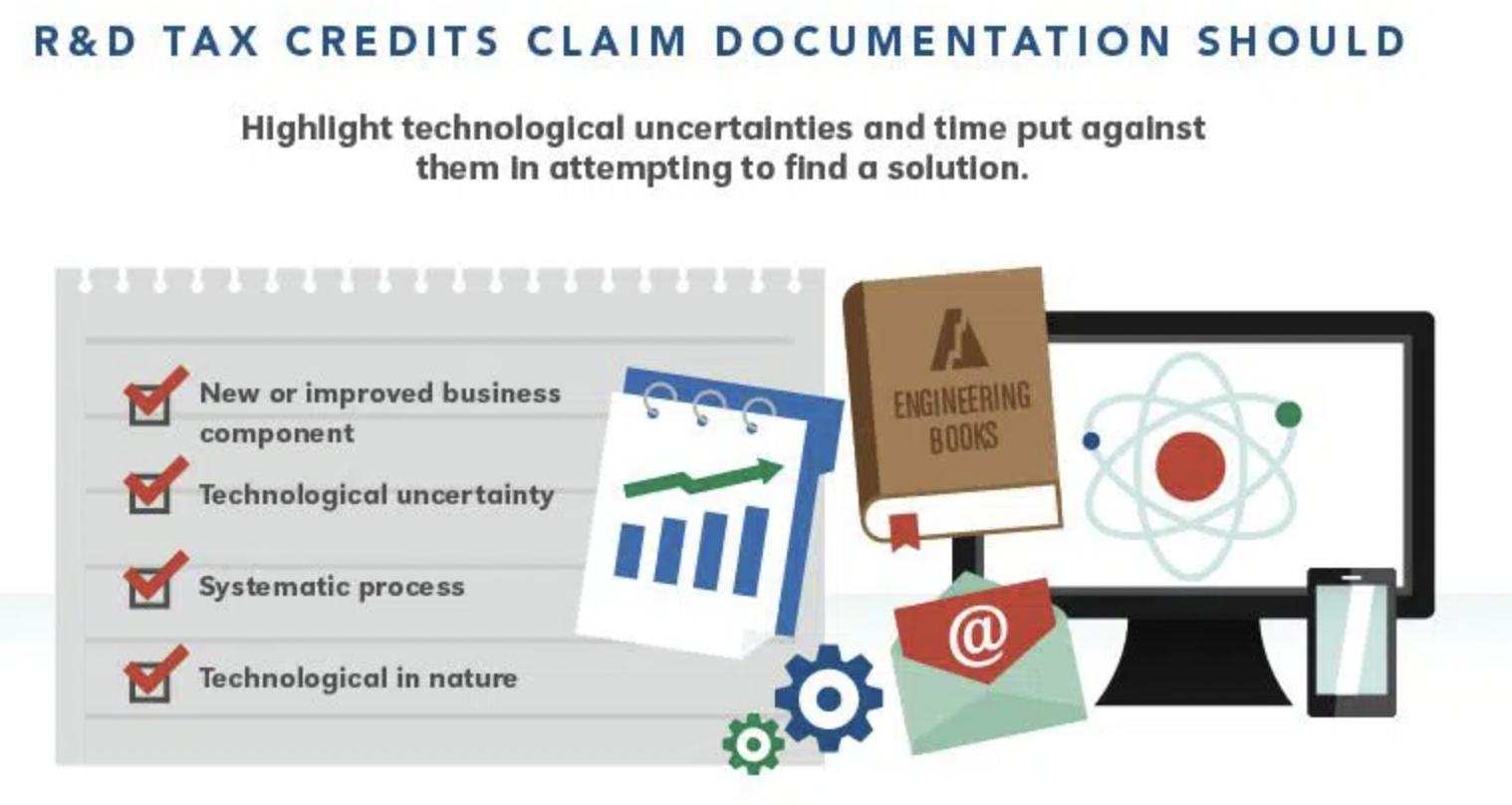
Four broad categories define research and development work, also known as qualified research activities (QRAs). They include:
- Permitted purpose – Work done to develop new or improved products or processes
- Technological uncertainty – Work done to find a new solution or method that’s previously been unsolvable with publicly available information or knowledge
- Process of experimentation – Work done in a systematic process to evaluate one or more alternatives
- Technological in nature – Work done in physical sciences, biology, engineering, or computer science
The expenses that contribute to one or more of these categories, which are known as qualified research expenses (QREs), and count toward the tax credits include:
- Patents
- R&D supplies
- Salaries for US employees
- Salaries for US subcontractors
- Hosting costs (rentals for off-premise computers and other tech)
Frequently asked questions about R&D Tax Credits
What can you recover with R&D tax credits?
The R&D tax credits you can recover can be broken down into two parts — federal and state. The Federal portion is approximately 10% of eligible expenditures that can be used to offset Social Security taxes up to $250,000 per year, income taxes, or the alternative minimum tax (AMT). However, the state portion is different from state to state.
What are the benefits of R&D tax credits?
R&D tax credits can be used to offset the employer portion of Social Security taxes up to $250,000 for each fiscal year.
The Social Security tax offset allows qualified small businesses to receive a benefit for their research activities regardless of profitability. R&D tax credits can also be used to offset income taxes if you’re in a taxable position, which is dependent on your previous tax return statements.
R&D tax credits can also be used to offset the alternative minimum tax (AMT) if you have less than $50 million in average revenue for the three previous years and you owe AMT in the current year.
How do you prepare the documents for R&D tax credits?
Although the R&D Tax Credit program can help your business recover large amounts of your research and development spend, claiming the tax credits is a complicated process. You’ll need to provide evidence in the form of receipts and invoices for QREs.
The IRS and state revenue collection agencies have their own requirements, but many follow the federal guidelines for their state’s credits. Requirements for documentation include:
- Documents need to be contemporaneous, meaning the R&D expense needs to be documented as it occurs. The bigger the claim, the more documents you’ll need to collect.
- There needs to be proof the work occurred in the fiscal year being claimed. All documents supporting the QREs need to be dated.
- Your claim needs to highlight technical challenges and substantiate the R&D work that was done. The challenges should reflect one of the four broad categories (as defined by the IRS) that qualify as R&D work.
Tax professionals with industry experience assure your claim for R&D tax credits is backed up well and offer a sufficient explanation of R&D activities should the IRS audit your organization.
Boast finds the credits for you — with no upfront fee
Boast combines AI-driven software that finds opportunities for credits with the professional touch of our in-house R&D tax experts. We’ll work to get your business larger returns faster with less work.
Our staff is made up of engineers and finance professionals backed by over 20 years of experience in the field. We stay engaged with your business throughout the year to help you identify R&D eligible work, which enables us to provide information on other technology grants and financing opportunities.
And if the IRS reviews your R&D claim, we’ll defend you in the process and help to ensure your claim is successful. Get in touch with us now to request a free assessment and get started on your next R&D claim.
Use our R&D tax credit calculator to estimate your tax refund.